
Highlighting the achievements of ISRO, he said the organization, which had modest beginnings several decades ago, is trying to establish itself as the leading player in the area of satellite launches.
There is no independent audit to investigate the cause of death and the regulator simply takes the word of the investigator.

Here is the timeline of the moon mission as undertaken by the Indian Space Research Organisation.

While industry is upbeat, start-ups in the space sector are finding it difficult to cater to the demand due to a lack of funding, issues related to policy like foreign funding, intellectual property, etc, and a lack of support in testing.
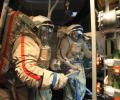
Four Indian Air Force fighter pilots are currently under training in Moscow, and are likely to be potential candidates for the Gaganyaan project.

The National Security Strategy document should flag all major issues concerning security strategy and provide guidelines to concerned departments to work out suitable action plans. Since the global and regional geopolitical canvas is dynamic, the NSS document should be deliberated at length before formulation and should be reviewed periodically, recommends Commodore Venugopal Menon (retd).

Here is ISRO's SAC Director, Nilesh M Desai explains the crucial stage of soft landing.
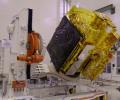
This mission will study astronomical phenomena, puts India in select group of nations

Once deployed and operational, it will be used to support the satellite imagery requirements of various agencies within the government of Singapore.
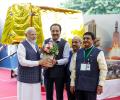
August 23, the day the Chandrayaan-3 lander touched down on the lunar surface, would be celebrated as 'National Space Day'.
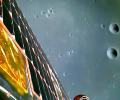
Taking to X (formerly Twitter), ISRO said, "Chandrayaan-3 Mission. Chandrayaan-3 Rover to MOX, ISTRAC, Moon walk begins!"

The 1994 Indian Space Research Organisation (ISRO) espionage case, in which former space scientist Nambi Narayanan was falsely implicated, was allegedly created by a then special branch officer of Kerala police to justify his illegal detention of a Maldivian woman in India after she spurned his advances, the Central Bureau of Investigation has told a court in Thiruvananthapuram.
The T-52 hour countdown for the launch of the PSLV-C7 began at 0548 hours on Monday, and it was progessing smoothly.

'You don't want to harm the satellites of other countries, but you also don't want your own satellite to be harmed.'

This image features the left image within the red channel, and the right image within the blue and green channels, resulting in a striking cyan hue.

XPoSat or X-ray Polarimeter Satellite is India's first dedicated polarimetry mission to study various dynamics of bright astronomical X-ray sources in extreme conditions.

ISRO chairman S Somanath on Monday said instead of a success-based design in Chandrayaan-2, the space agency opted for a failure-based design in Chandrayaan-3, focused on what all can fail and how to protect it and ensure a successful landing.

ISRO has an opportunity to be the one-stop shop for satellite manufacturing, and Alpha Design is just the booster it needed.

India is all set for the maiden launch on Monday of an indigenous winged Reusable Launch Vehicle--that is being dubbed as its own space shuttle--from Sriharikota spaceport in Andhra Pradesh.

The primary satellite TeLEOS-2 is a synthetic aperture radar satellite developed under partnership between Defence Science and Technology Agency (DSTA) representing the Government of Singapore and ST Engineering.

As more than 400 candidates from a single state -- Haryana -- had taken the test, there are suspicions over whether coaching centres may be involved.

The Trans-Lagrangian Point 1 Insertion manoeuvre marks the beginning of the spacecraft's about 110-day trajectory to the destination around the L1 Lagrange point, a balanced gravitational location between the Earth and the Sun.
New Delhi has targeted to boost the number of transponders India currently has from 199 to 500 by the end of the 11th five year plan (March 2012), Secretary in the Department of Space G Madhavan Nair said.

The 25-hour countdown has begun for the launch of the Indian Space Research Organisation's PSLV-C53 mission in Sriharikota.

ISRO will now conduct further testing of VELC and its eventual integration with the Aditya-L1 spacecraft, it said in a release.

The ISRO on Sunday scripted yet another history after its LVM3 rocket successfully placed 36 satellites of United Kingdom-based OneWeb group company into intended orbits.

India scripted history as the ambitious third Moon mission of the Indian Space Research Organisation (ISRO) touched down on the Moon's south pole, propelling the country to an exclusive club of four and making it the first nation to land on the uncharted surface.
With a view to increase its surveillance capabilities, the Indian Air Force is going to have its own satellite in space by the end of 2010. "We will launch our satellite by the end of 2010," IAF chief Air Chief Marshal Fali Homi Major said in Bangalore on Thursday.

Film folk like Akshay Kumar, Chiranjeevi, Jr NTR and Sunny Deol congratulated the country and the Indian Space Research Organisation (ISRO) on the historic achievement of Chandrayaan-3's landing on the Moon.
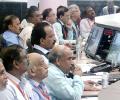
Leading scientists and experts said this monumental accomplishment not only marks India's indelible imprint on lunar exploration but also demonstrates the prowess of human collaboration, determination, and cutting-edge technology.

'India has got a unique opportunity to get more and more business from outside as India is cost-effective and reliable.'

It's time India re-visited its Western alliances for the attitude and approach that the West reserves for the nation when it comes to security cooperation of the kind that they might not have visualised outside of China, India's bug-bear, asserts N Sathiya Moorthy.

In the years to come, India's space assets will play a much bigger role if and when hostilities break out on our borders, says Pallava Bagla.
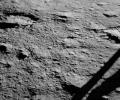
Speaking to PTI, Somanath said, "(The lander landed) perfectly in the intended site. The landing location was marked as 4.5 km x 2.5 km -- I think on that space, and the exact centre of that was identified as the location of landing. It landed within 300 metres of that point. That means it is well within the area identified for landing."

The test vehicle development flight (TV-D1) is aimed at testing the crew module that will carry Indian astronauts during the human spaceflight late next year.

Thousands of workers of every description -- from journalists to steel workers, from painters to New York cops, from auto to engineering workers -- marched for two hours down 5th Avenue one of Manhattan's most iconic thoroughfares, reports Jyoti Punwani.

A team of Indian Space Research Organisation scientists on July 13 visited the Tirupati Venkatachalapathy temple ahead of Friday's much anticipated Chandrayaan-3 launch.

Scientists expect to get new information about the past, present and future of the Sun after analysing the data that will be collected by India's first solar mission Aditya-L1, scheduled to be launched by Indian Space Research Organisation (ISRO) on September 2.
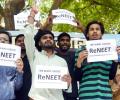
The top court said since the remit of the panel has been expanded, the committee would submit its report by September 30 on various measures to rectify deficiencies in the examination system.
